How Do Pinhole Glasses Work? The Physics of Stenopeic Optics Explained
When someone puts on a pair of authentic pinhole glasses in a well-lit room for the first time, the most common reaction is surprise: without a single curved glass or plastic lens in the frame, blurry print on a book page or television screen suddenly looks noticeably sharper. There is nothing mysterious about this effect—it relies on a classic principle of geometrical optics known as the stenopeic (pinhole) effect.
1. Why Unfocused Eyes See Blur: The Circle of Confusion
In an eye with no refractive error, the cornea and crystalline lens bend incoming rays of light from every part of the pupil so they converge cleanly onto a single focal point on the retina. When an eye is nearsighted (myopic), farsighted (hyperopic), presbyopic, or astigmatic, rays entering near the outer edges of the pupil land slightly in front of or behind the retina instead of meeting at one point.
Instead of forming a crisp point, each tiny detail in the scene spreads into a fuzzy disc called the circle of confusion. When thousands of overlapping blur circles pile up on the retina, text edges look soft, doubled, or washed out.
2. The Camera Aperture Analogy (f-Stop Depth of Field)
Photographers use the exact same physics every day. A camera lens wide open at f/1.4 has a very shallow depth of field—anything slightly out of focus blurs immediately. Stop that same lens down to f/16 or f/22 (a tiny aperture), and objects both near and far become sharp at the same time.
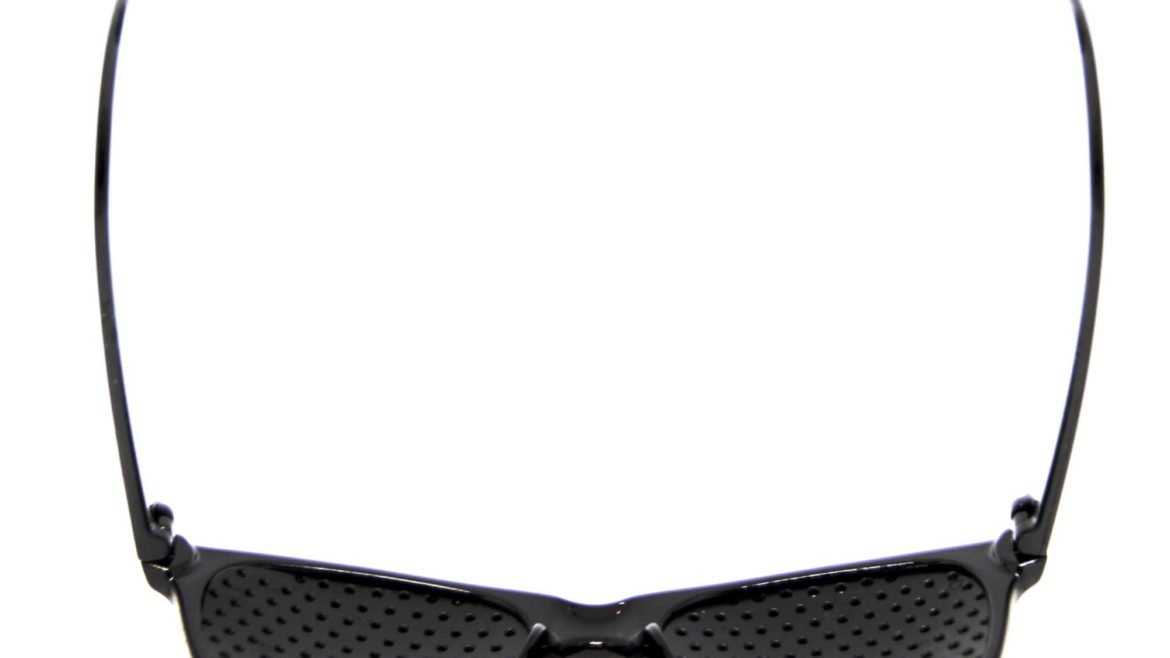
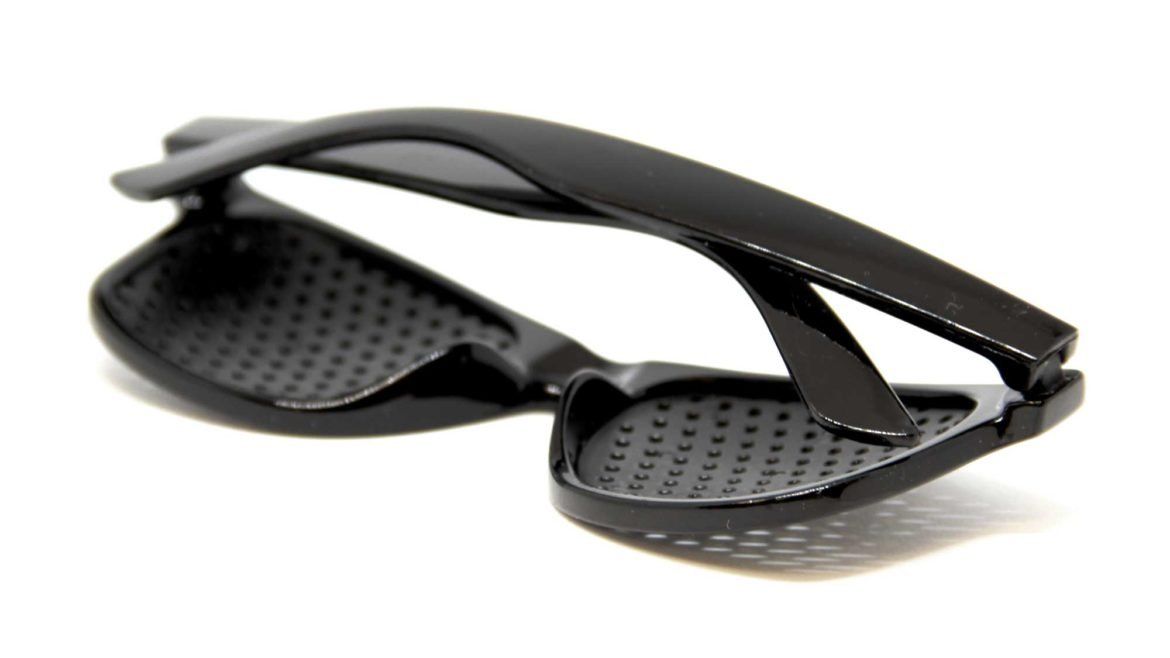
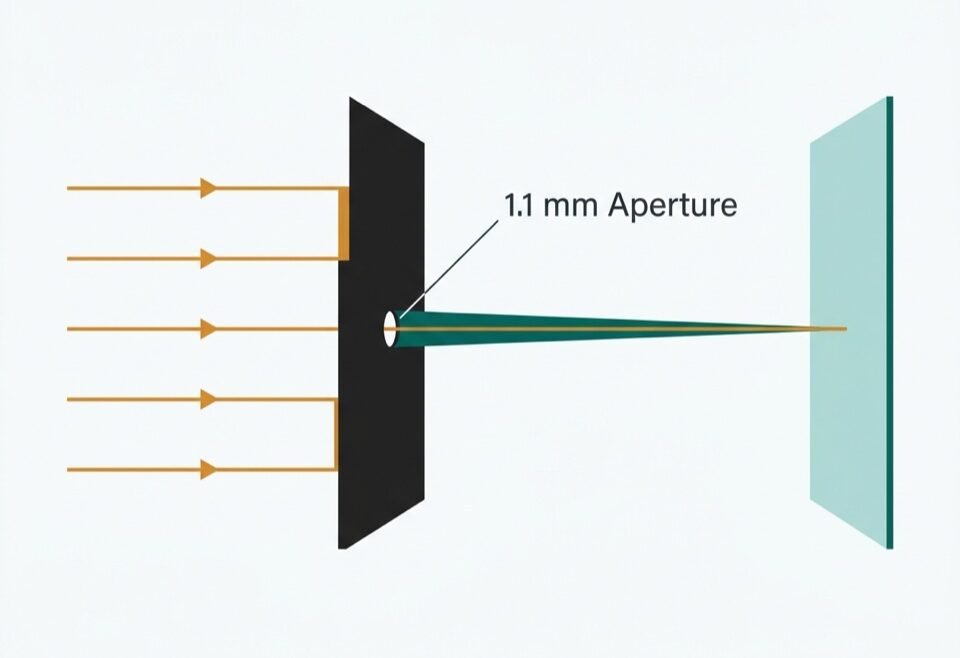
Stenopeic glasses place an opaque matte-black screen perforated with tiny 1.1 mm apertures in front of each eye. Each perforation blocks wide-angle peripheral rays and admits only a narrow, centered pencil of light straight through the middle of your pupil. Because narrow central rays barely diverge, the blur circle on the retina shrinks dramatically—increasing depth of field instantly.
3. Why Eye Doctors Use a Single Pinhole Occluder During Eye Exams
Optometrists and ophthalmologists routinely use a single-hole clinical instrument called a pinhole occluder during standard eye examinations. If a patient’s distance chart acuity improves when looking through a ~1.0–1.2 mm pinhole, it tells the clinician that the blur is primarily optical (refractive) rather than caused by retinal or optic-nerve disease.
Consumer stenopeic eyewear applies that optical principle across a honeycomb grid of holes spaced 2.5 mm apart, allowing your gaze to move comfortably across a book page or television screen rather than peeking through one fixed opening.
4. Why Aperture Diameter (1.1 mm) and Matte Nylon Matter
- Too Large (> 1.5 mm): Wide holes let too many off-axis rays enter the pupil, leaving text blurry.
- Too Tiny (< 0.8 mm): Light waves bend around microscopic edges (Fraunhofer diffraction), creating fuzzy halos while making the view overly dark.
- 1.1 mm Optimal Balance: Precision 1.1 mm perforations in non-reflective matte Nylon minimize internal rim glare while maintaining clear indoor contrast.
5. Realistic Expectations & Safe Indoor Use
Understanding optical physics also clarifies what pinhole glasses can and cannot do:
- Immediate Optical Clarity While Worn: Text and contours appear crisper while looking through the apertures in bright ambient light.
- Not a Medical Cure: Pinhole glasses do not reshape the cornea or permanently cure myopia, astigmatism, or eye disease, and they never replace comprehensive eye exams.
- Stationary Indoor Use Only: Because the opaque grid blocks roughly two-thirds of incoming light and restricts side vision, never wear pinhole glasses for driving, walking in traffic, stairs, or operating equipment.
Ready to experience stenopeic optics firsthand? Explore our 1.1 mm Pinhole Glasses here or read our 10–15 minute daily indoor usage guide.