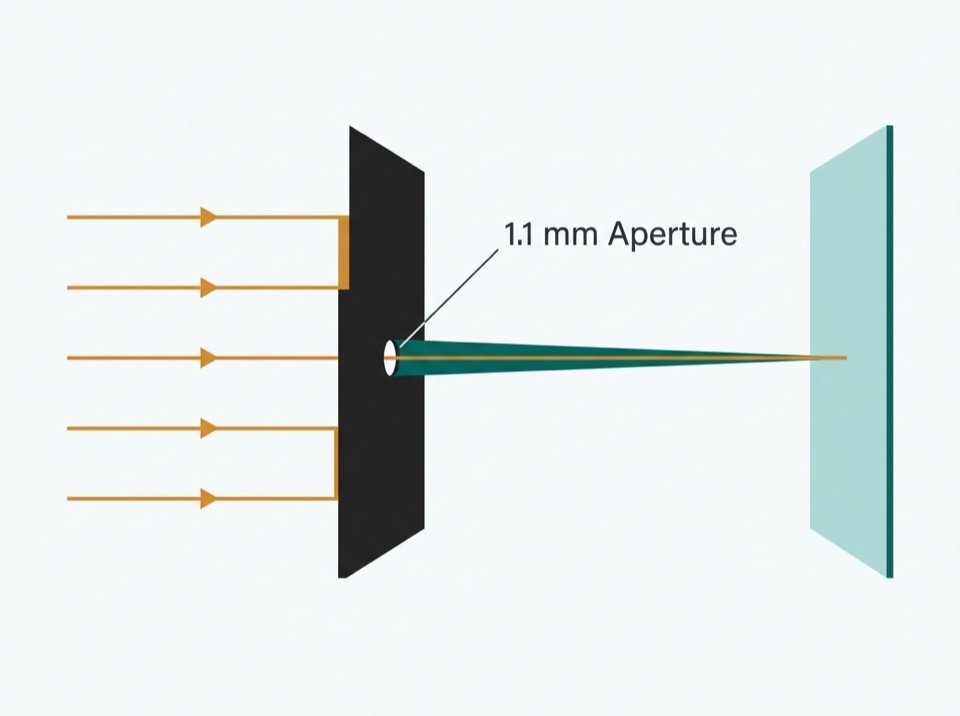
Important Medical & Optical Fact: Pinhole glasses do not treat, cure, or permanently improve nearsightedness (myopia), farsightedness (hyperopia), presbyopia, or astigmatism, and are not a substitute for prescription lenses or medical eye care. This educational guide explains purely why looking through a 1.1 mm pinhole temporarily narrows the retinal blur circle only while worn in bright indoor light—the same optical physics demonstrated in physics classrooms.
Unlike prescription eyeglasses that must be ground to a specific sphere, cylinder, and axis for one individual, stenopeic pinhole glasses act universally through depth-of-field geometry. How crisp objects look while wearing them indoors depends on the optical nature of the blur.
1. Mild-to-Moderate Distance Blur (Myopia Under 6.00 Diopters)
Adults with mild or moderate nearsighted blur typically notice sharper edges when viewing across-the-room indoor targets such as a television screen or wall clock in bright ambient light. With higher prescriptions above -6.00 diopters, the unfocused blur circle is wide enough that dark grid lines between apertures feel more prominent, making perforated eyewear less comfortable.
2. Close-Up Age-Related Blur (Presbyopia) & Farsightedness
When close-up focus becomes harder under low light, narrowing incoming light beams through 1.1 mm apertures under a bright reading lamp increases near depth of field while worn indoors. For tiny medication labels, threading needles, or dim workbenches where bright task lighting and true lens enlargement are needed, consider our 160% LED Magnifying Glasses instead.
3. Mild Regular Astigmatism
When a cornea bends light unevenly along two meridians, points of light stretch slightly. Blocking outer peripheral rays so only a narrow central beam enters the pupil reduces meridian blur strictly while looking through the holes indoors.
When Pinhole Glasses Will NOT Help
Honest optical guidance matters for your safety. Because pinhole screens block roughly 60–70% of light and only affect geometrical focus, they cannot clear vision loss caused by clouding inside the eye or retinal/optic-nerve conditions—in fact, dimming incoming light can make low-contrast rooms harder to see. Always consult a licensed optometrist or ophthalmologist for any new or changing vision symptoms.
Review full optical specifications and safety warnings on our 1.1 mm Pinhole Glasses product page.
